|
|
Classical music: American Choral Music (Naxos, 8.559358) |
|
| |
'University of Texas Chamber Singers, James Morrow - conductor' | Sat, 03 Mar 2012 23:47:34 GMT | Автор: kgkk |
|
| |
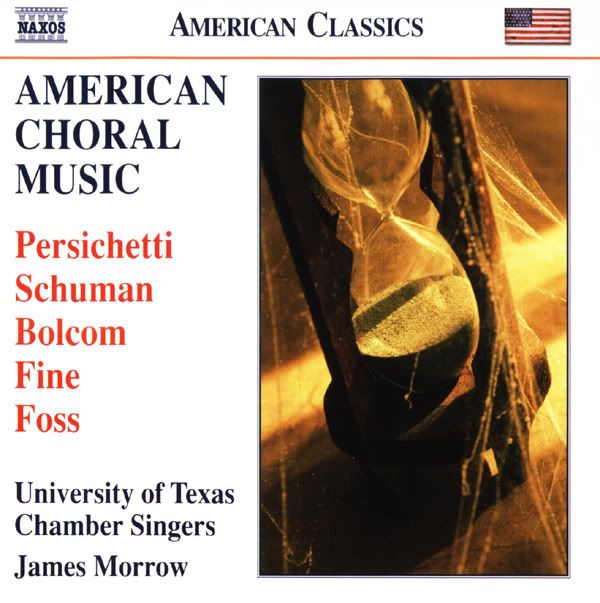 |
| Артист: |
University of Texas Chamber Singers |
| Альбом: |
American Choral Music, 2010 |
| Издатель: |
Naxos / 8.559358 |
| Жанр: |
Classical |
| Формат файла: |
EAC / FLAC / CUE / LOG |
| Ссылка: |
CD |
| Нахождение: |
Torrent |
|
American Choral MusicPersichetti • Schuman • Bolcom • Fine • FossLabel: Naxos, 8.559358 Year: 2010 Performers:Dwight Bigler and Alena Gorina - pianos University of Texas Chamber Singers James Morrow - conductor Tracklist:Vincent Persichetti (1915-1987) Mass (1960) William Schuman (1910-1992) Carols of Death William Bolcom (b. 1938) The Mask (1990) Irving Fine (1914-1962) The Hour-Glass (1949) Lukas Foss (1922-2009) Psalms (1956) 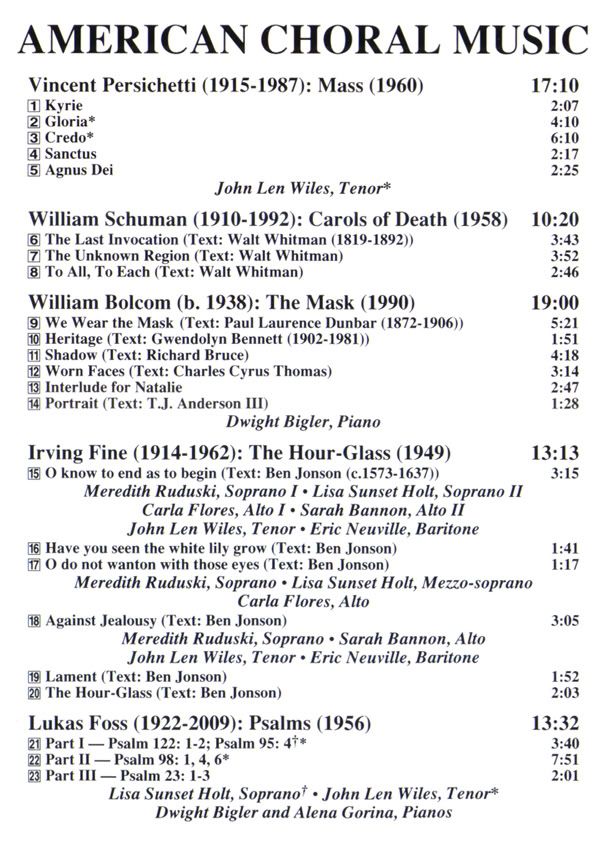 Born in 1915, composer, pianist, and educator Vincent Persichetti demonstrated his musical ability from an early age. During his career, he worked at the Philadelphia Conservatory and The Juilliard School, where he was head of both the Composition and the Literature and Materials of Music departments. Persichetti wrote a wide range of works for many genres and ensemble types over the course of his lifetime, including compositions for solo piano, symphonic band, and choir. Born in 1915, composer, pianist, and educator Vincent Persichetti demonstrated his musical ability from an early age. During his career, he worked at the Philadelphia Conservatory and The Juilliard School, where he was head of both the Composition and the Literature and Materials of Music departments. Persichetti wrote a wide range of works for many genres and ensemble types over the course of his lifetime, including compositions for solo piano, symphonic band, and choir.
New York’s Collegiate Chorale commissioned Persichetti to write Mass for Mixed Chorus, A Cappella in 1960, singing at its Carnegie Hall debut in 1961. The a capella setting of the Mass Ordinary is brief, planned by the composer to be a liturgical-style, rather than a longer concert-length Mass setting. Thus, the work’s length and form, if not its relative difficulty, conform to the limits and requirements of the Mass. The full ensemble introduces the darkly minor cantus firmus in the first two measures of the Kyrie. From the unison, the voices split into two parts for the first statement of the Kyrie, with the tenor and bass doubling the soprano and alto at the octave. The middle Christie eleison section opens up into four-part writing, before the settling back into the Kyrie. The next movement, Gloria, returns to the cantus firmus, and the Credo also opens with the tenors and basses slowly intoning the cantus. Persichetti’s measured but persistent return to the thematic core of the cantus firmus parallels a compositional technique found throughout his work. After a long and intense Credo, the choir arrives at the reverent Sanctus, travelling through many pitch centers before a ringing final cadence on D. Persichetti brings together the firmus and new melodies in the Agnus Dei, ending the work on a peaceful unison as the choir exhorts the final "dona nobis pacem" (grant us peace).
William Howard Schuman wrote Carols of Death in 1958 after receiving a commission from St Lawrence University in New York. A life-long New Yorker named after President William Howard Taft, Schuman began his musical career as a composer of popular songs before beginning to study composing more formally in 1930. In 1945 he was appointed president of The Juilliard School, where he proceeded to reorganize and reenergize the school before becoming the president of the Lincoln Center for the Arts in 1962. He continued to compose after his retirement, during which time he also received several national honors including the National Medal of Arts in 1987.
Although remembered primarily as a symphonic composer, Schuman also composed string quartets, operas, concerto, ballet, and choral works. Carols of Death is among several works featuring texts from Walt Whitman, including the Pulitzer-prize winning A Free Song (Secular Cantata No. 2). The title Carols of Death comes from the last of the three texts Schuman set, a single stanza from Whitman’s elegy to Abraham Lincoln When Lilacs Last in the Dooryard Bloom’d. Most phrases in the first carol, The Last Invocation, begin with the voices in unison, and then expand outwards in measured stepwise motion. Much of The Last Invocation features two-part writing, accented by a repeated four-part texture on "tenderly." The next carol, The Unknown Region begins with excited repetitions of "Darest thou now O Soul," part of a rhythmic canon featuring dramatic terraced entrances in the voices. Schuman ends this movement not with a clear resolution, but rather with deliberate restlessness on the text "the unknown region," which pushes the listener into the final carol, To All, To Each. With precision and bell-like resonance the voices enter on the text "Come" before proceeding into the rest of the line ("lovely and soothing and death"). By the end of the final movement, Schumann resolves most-but not all-of the remaining melodic and harmonic tension, reflecting the final text from Whitman’s work, "To all, to each / Sooner or later delicate death."
Although remembered primarily as a symphonic composer, Schuman also composed string quartets, operas, concerto, ballet, and choral works. Carols of Death is among several works featuring texts from Walt Whitman, including the Pulitzer-prize winning A Free Song (Secular Cantata No. 2). The title Carols of Death comes from the last of the three texts Schuman set, a single stanza from Whitman’s elegy to Abraham Lincoln When Lilacs Last in the Dooryard Bloom’d. Most phrases in the first carol, The Last Invocation, begin with the voices in unison, and then expand outwards in measured stepwise motion. Much of The Last Invocation features two-part writing, accented by a repeated four-part texture on "tenderly." The next carol, The Unknown Region begins with excited repetitions of "Darest thou now O Soul," part of a rhythmic canon featuring dramatic terraced entrances in the voices. Schuman ends this movement not with a clear resolution, but rather with deliberate restlessness on the text "the unknown region," which pushes the listener into the final carol, To All, To Each. With precision and bell-like resonance the voices enter on the text "Come" before proceeding into the rest of the line ("lovely and soothing and death"). By the end of the final movement, Schumann resolves most-but not all-of the remaining melodic and harmonic tension, reflecting the final text from Whitman’s work, "To all, to each / Sooner or later delicate death."
Given its premiere in 1991, The Mask is the most recent composition included on this recording. In it William Bolcom exhibits the deep diversity of his musical language. The project began at the suggestion of pianist Natalie Hinderas, and developed into a song cycle with not only a significant piano accompaniment, but also an entire movement (Interlude for Natalie) for solo piano. The text for the five choral movements features poems from African American poets since the Harlem Renaissance, united by the theme of the mask and hidden identity. The first song begins with a dark piano introduction before the choir intones, "we wear the mask that grins and lies" from Paul Laurence Dunbar’s poem We Wear the Mask. The ragtime rhythms and harmonies that begin the next movement, Heritage, make the longing for identity in Gwendolyn B. Bennett’s poem all the more poignant. After the choir sings the final lines ("I want to feel the surging / of my sad people’s soul / Hidden by a minstrel smile") the piano’s ragtime voice loses its bearing and falls away.
During his career as a composer, teacher, and conductor, native Bostonian Irving Fine taught at Harvard and Brandeis, and developed close friendships with other American composers including Aaron Copland. Fine was on faculty at Tanglewood for almost a decade, where he wrote The Hour-Glass in 1949. Based on an eclectic selection of poems from the seventeenth-century English poet Ben Jonson, The Hour-Glass showcases Fine’s skill at vocal writing including his careful attention to text setting. From the opening of this a cappella work O know to end as to begin the extraordinary technique Fine brought to his choral writing is audible. The texture is intricate and quite varied, but the listener can still hear each distinct syllable. In several movements, Fine combines the full choir with small groups of soloists. For example, in O do not wanton with those eyes the full choir alternates with a small ensemble of solo female voices. The final movement, The Hour-Glass, contains reflections on death and love, concluding with the line "even ashes of lovers find no reSt "
Lukas Foss began to compose at the age of seven, several years before he and his family fled Nazi Germany in 1933. His long career included a membership in the National Institute of Arts and Letters, founding the Creative Associates at SUNY Buffalo and conducting the Brooklyn Philharmonic. He played a central role in organizing and supporting American new music in the twentieth century and maintained a prolific compositional career, earning the label "eclectic."
Psalms (for mixed chorus and two pianos) opens with an Andante movement, featuring long tenor and soprano solo lines, sparse piano accompaniment and a brief choral interlude for the tenors and basses. The fast middle movement is the longest in Psalms and begins with a snippet from Psalm 96, the male voices in unisons on "sing unto the Lord!" This demanding movement ends with a long, joyful piano coda before transitioning into the quiet final movement. In slow, subdued legato lines the six-part chorus ends with text from Psalm 23. The sopranos conclude this work on a soft high A, enacting the lifting of hearts that opens Foss’s Psalms.Perhaps this disc should bear the title "American Choral Music, Volume 2", as this same choir--a world-class group in every respect--released a similarly interesting, well-chosen, and impeccably-sung program of American works (by Ives, Corigliano, Persichetti, Foss, and Copland) for this same label in 2007 (type Q11034 in Search Reviews). Choral music fans should be very grateful to James Morrow and his excellent young singers, not only for the exemplary choral performances but for documenting repertoire that inexplicably remains rarely recorded.
Vincent Persichetti's Mass could function equally well as a liturgical or concert piece, and its vibrant harmonic character--that somewhat ambiguous yet still tonal melding of modal aspects with added- and subtracted-note triadic structures, sometimes described (in the latter 20th-century) as "modern-classicism"--works very well with the timbres of voices, and after hearing the University of Texas Chamber Singers' absolutely dead-on rendition, you just want to go out and perform the work yourself. It's as finely written and attractive a piece of 20th-century sacred music as you'll hear, and it's not so difficult as to be beyond the reach of serious amateur choirs.
William Schuman's Carols of Death, set to texts by Walt Whitman, are in their own way just as affecting and memorable as the Persichetti, even if the technical demands for the singers are that much greater and likewise the challenges for the listener. William Bolcom's The Mask (the program's most recently composed work), a song cycle with piano based on poems by African American poets, shows a (mostly) skillful integration of sung texts and music, engages the ear and emotions with its clever references to ragtime and blues--and features one movement of solo piano, which is among the disc's highlights. In the first movement the piano sometimes seems superfluous or even irrelevant to the choral parts, and the piano's clamorous bass just sounds excessive (a clue to this very percussive quality may be found in the texts, but these are only available online).
The earliest work on the program, Irving Fine's The Hour-Glass, sets six poems by 17th-century English poet Ben Jonson. Not only is this by far the most virtuosic group of pieces on the disc, but Fine's text-setting is the most imaginative and effective and masterful. The soloists here are outstanding. Finally, Lukas Foss' Psalms are typically easily accessible (not that there's anything wrong with that!) but also typically just a bit frothy (a word I always find myself using with this composer), but you can't help but love the Psalm 23, which gently, peacefully closes the disc, the sopranos floating a lovely high-A. The sound, from a church in Austin, Texas, is sensitive and true to the singers and (except for the one above-mentioned instance) to the piano(s). A superb and important addition to the catalog--highly recommended. [12/13/2010]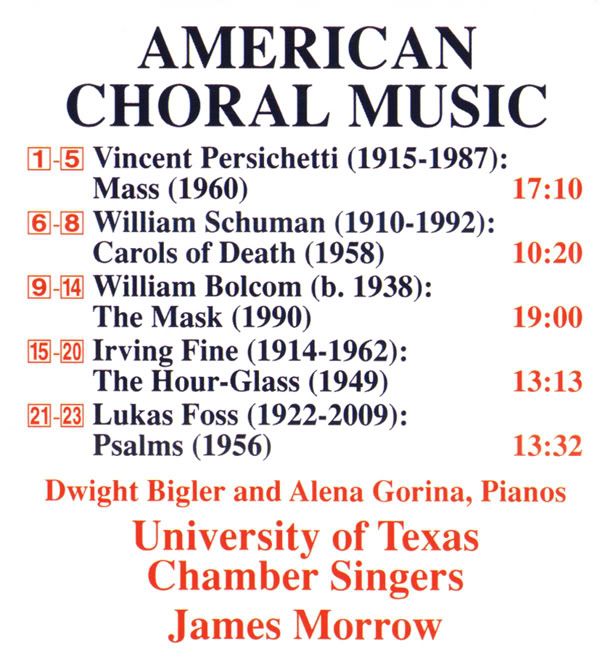 | SPOILER (LOG FILE) | Exact Audio Copy V1.0 beta 1 from 15. November 2010
EAC extraction logfile from 24. May 2011, 11:08
University of Texas Chamber Singers / American Choral Music
Used drive : HL-DT-STDVDRAM GSA-H62N Adapter: 2 ID: 1
Read mode : Secure
Utilize accurate stream : Yes
Defeat audio cache : Yes
Make use of C2 pointers : No
Read offset correction : 667
Overread into Lead-In and Lead-Out : No
Fill up missing offset samples with silence : Yes
Delete leading and trailing silent blocks : No
Null samples used in CRC calculations : Yes
Used interface : Installed external ASPI interface
Gap handling : Appended to previous track
Used output format : User Defined Encoder
Selected bitrate : 256 kBit/s
Quality : High
Add ID3 tag : No
Command line compressor : C:\Program Files\Exact Audio Copy\Flac\flac.exe
Additional command line options : -8 -V -T "ARTIST=%a" -T "TITLE=%t" -T "ALBUM=%g" -T "DATE=%y" -T "TRACKNUMBER=%n" -T "TOTALTRACKS=%x" -T "GENRE=%m" -T "ALBUMARTIST=%v" -T "ALBUM ARTIST=%v" -T "COMMENT=EAC Secure Mode, Test & Copy, AccurateRip, FLAC -8" %s
TOC of the extracted CD
Track | Start | Length | Start sector | End sector
---------------------------------------------------------
1 | 0:00.00 | 2:08.57 | 0 | 9656
2 | 2:08.57 | 4:09.53 | 9657 | 28384
3 | 6:18.35 | 6:11.42 | 28385 | 56251
4 | 12:30.02 | 2:19.08 | 56252 | 66684
5 | 14:49.10 | 2:26.11 | 66685 | 77645
6 | 17:15.21 | 3:39.55 | 77646 | 94125
7 | 20:55.01 | 3:53.31 | 94126 | 111631
8 | 24:48.32 | 2:48.59 | 111632 | 124290
9 | 27:37.16 | 5:17.17 | 124291 | 148082
10 | 32:54.33 | 1:49.56 | 148083 | 156313
11 | 34:44.14 | 4:15.57 | 156314 | 175495
12 | 38:59.71 | 3:15.02 | 175496 | 190122
13 | 42:14.73 | 2:46.28 | 190123 | 202600
14 | 45:01.26 | 1:33.12 | 202601 | 209587
15 | 46:34.38 | 3:11.26 | 209588 | 223938
16 | 49:45.64 | 1:40.48 | 223939 | 231486
17 | 51:26.37 | 1:16.61 | 231487 | 237247
18 | 52:43.23 | 3:06.17 | 237248 | 251214
19 | 55:49.40 | 1:49.65 | 251215 | 259454
20 | 57:39.30 | 2:08.01 | 259455 | 269055
21 | 59:47.31 | 3:33.18 | 269056 | 285048
22 | 63:20.49 | 7:51.00 | 285049 | 320373
23 | 71:11.49 | 2:01.35 | 320374 | 329483
Track 1
Filename G:\University of Texas Chamber Singers - American Choral Music (2010) [FLAC]\01 - Vincent Persichetti - Mass, Op.84 - Kyrie.wav
Pre-gap length 0:00:02.00
Peak level 30.1 %
Extraction speed 2.5 X
Track quality 100.0 %
Test CRC 79C6D923
Copy CRC 79C6D923
Track not present in AccurateRip database
Copy OK
Track 2
Filename G:\University of Texas Chamber Singers - American Choral Music (2010) [FLAC]\02 - Vincent Persichetti - Mass, Op.84 - Gloria.wav
Pre-gap length 0:00:03.52
Peak level 73.5 %
Extraction speed 2.5 X
Track quality 99.9 %
Test CRC B1849F3B
Copy CRC B1849F3B
Track not present in AccurateRip database
Copy OK
Track 3
Filename G:\University of Texas Chamber Singers - American Choral Music (2010) [FLAC]\03 - Vincent Persichetti - Mass, Op.84 - Credo.wav
Pre-gap length 0:00:03.28
Peak level 55.6 %
Extraction speed 2.7 X
Track quality 99.9 %
Test CRC F0808D3E
Copy CRC F0808D3E
Track not present in AccurateRip database
Copy OK
Track 4
Filename G:\University of Texas Chamber Singers - American Choral Music (2010) [FLAC]\04 - Vincent Persichetti - Mass, Op.84 - Sanctus.wav
Pre-gap length 0:00:04.52
Peak level 42.1 %
Extraction speed 2.6 X
Track quality 100.0 %
Test CRC F835AC5D
Copy CRC F835AC5D
Track not present in AccurateRip database
Copy OK
Track 5
Filename G:\University of Texas Chamber Singers - American Choral Music (2010) [FLAC]\05 - Vincent Persichetti - Mass, Op.84 - Agnus Dei.wav
Pre-gap length 0:00:06.28
Peak level 31.8 %
Extraction speed 2.6 X
Track quality 100.0 %
Test CRC 78E66FEA
Copy CRC 78E66FEA
Track not present in AccurateRip database
Copy OK
Track 6
Filename G:\University of Texas Chamber Singers - American Choral Music (2010) [FLAC]\06 - William Schuman - Carols of Death - No.1.The Last Invocation.wav
Pre-gap length 0:00:07.49
Peak level 64.3 %
Extraction speed 2.8 X
Track quality 100.0 %
Test CRC 991A133C
Copy CRC 991A133C
Track not present in AccurateRip database
Copy OK
Track 7
Filename G:\University of Texas Chamber Singers - American Choral Music (2010) [FLAC]\07 - William Schuman - Carols of Death - No.2.The Unknown Region.wav
Pre-gap length 0:00:04.25
Peak level 58.9 %
Extraction speed 2.5 X
Track quality 99.9 %
Test CRC F0CC52B4
Copy CRC F0CC52B4
Track not present in AccurateRip database
Copy OK
Track 8
Filename G:\University of Texas Chamber Singers - American Choral Music (2010) [FLAC]\08 - William Schuman - Carols of Death - No.3.To All, To Each.wav
Pre-gap length 0:00:06.10
Peak level 23.0 %
Extraction speed 2.7 X
Track quality 100.0 %
Test CRC A663B22D
Copy CRC A663B22D
Track not present in AccurateRip database
Copy OK
Track 9
Filename G:\University of Texas Chamber Singers - American Choral Music (2010) [FLAC]\09 - William Bolcom - The Mask - No.1.We Wear the Mask.wav
Pre-gap length 0:00:09.25
Peak level 42.9 %
Extraction speed 3.0 X
Track quality 100.0 %
Test CRC 219AE3B0
Copy CRC 219AE3B0
Track not present in AccurateRip database
Copy OK
Track 10
Filename G:\University of Texas Chamber Singers - American Choral Music (2010) [FLAC]\10 - William Bolcom - The Mask - No.2.Heritage.wav
Pre-gap length 0:00:05.46
Peak level 48.1 %
Extraction speed 2.5 X
Track quality 100.0 %
Test CRC 783A7B6A
Copy CRC 783A7B6A
Track not present in AccurateRip database
Copy OK
Track 11
Filename G:\University of Texas Chamber Singers - American Choral Music (2010) [FLAC]\11 - William Bolcom - The Mask - No.3.Shadow.wav
Pre-gap length 0:00:04.28
Peak level 30.6 %
Extraction speed 2.9 X
Track quality 100.0 %
Test CRC 0535BECE
Copy CRC 0535BECE
Track not present in AccurateRip database
Copy OK
Track 12
Filename G:\University of Texas Chamber Singers - American Choral Music (2010) [FLAC]\12 - William Bolcom - The Mask - No.4.Worn Faces.wav
Pre-gap length 0:00:01.67
Peak level 30.2 %
Extraction speed 2.8 X
Track quality 100.0 %
Test CRC C5168831
Copy CRC C5168831
Track not present in AccurateRip database
Copy OK
Track 13
Filename G:\University of Texas Chamber Singers - American Choral Music (2010) [FLAC]\13 - William Bolcom - The Mask - No.5.Interlude for Natalie.wav
Pre-gap length 0:00:02.37
Peak level 20.6 %
Extraction speed 2.2 X
Track quality 99.9 %
Test CRC E32DE810
Copy CRC E32DE810
Track not present in AccurateRip database
Copy OK
Track 14
Filename G:\University of Texas Chamber Singers - American Choral Music (2010) [FLAC]\14 - William Bolcom - The Mask - No.6.Portrait.wav
Pre-gap length 0:00:01.58
Peak level 48.7 %
Extraction speed 2.3 X
Track quality 100.0 %
Test CRC 6204E356
Copy CRC 6204E356
Track not present in AccurateRip database
Copy OK
Track 15
Filename G:\University of Texas Chamber Singers - American Choral Music (2010) [FLAC]\15 - Irving Fine - The Hour-Glass - No.1.O know to end as to begin.wav
Pre-gap length 0:00:06.40
Peak level 66.4 %
Extraction speed 2.8 X
Track quality 100.0 %
Test CRC 33F77676
Copy CRC 33F77676
Track not present in AccurateRip database
Copy OK
Track 16
Filename G:\University of Texas Chamber Singers - American Choral Music (2010) [FLAC]\16 - Irving Fine - The Hour-Glass - No.2.Have you seen the white lily grow.wav
Pre-gap length 0:00:02.34
Peak level 48.2 %
Extraction speed 2.4 X
Track quality 100.0 %
Test CRC E6431B79
Copy CRC E6431B79
Track not present in AccurateRip database
Copy OK
Track 17
Filename G:\University of Texas Chamber Singers - American Choral Music (2010) [FLAC]\17 - Irving Fine - The Hour-Glass - No.3.O do not wanton with those eyes.wav
Pre-gap length 0:00:02.31
Peak level 26.3 %
Extraction speed 2.2 X
Track quality 100.0 %
Test CRC 933AA52D
Copy CRC 933AA52D
Track not present in AccurateRip database
Copy OK
Track 18
Filename G:\University of Texas Chamber Singers - American Choral Music (2010) [FLAC]\18 - Irving Fine - The Hour-Glass - No.4.Against Jealousy.wav
Pre-gap length 0:00:01.64
Peak level 57.0 %
Extraction speed 2.7 X
Track quality 100.0 %
Test CRC B38B30FD
Copy CRC B38B30FD
Track not present in AccurateRip database
Copy OK
Track 19
Filename G:\University of Texas Chamber Singers - American Choral Music (2010) [FLAC]\19 - Irving Fine - The Hour-Glass - No.5.Lament.wav
Pre-gap length 0:00:03.43
Peak level 51.7 %
Extraction speed 2.4 X
Track quality 100.0 %
Test CRC 744310C7
Copy CRC 744310C7
Track not present in AccurateRip database
Copy OK
Track 20
Filename G:\University of Texas Chamber Singers - American Choral Music (2010) [FLAC]\20 - Irving Fine - The Hour-Glass - No.6.The Hour - Glass.wav
Pre-gap length 0:00:01.63
Peak level 58.2 %
Extraction speed 2.5 X
Track quality 100.0 %
Test CRC 86B788EF
Copy CRC 86B788EF
Track not present in AccurateRip database
Copy OK
Track 21
Filename G:\University of Texas Chamber Singers - American Choral Music (2010) [FLAC]\21 - Lukas Foss - Psalms - Part I - Psalm 122-1 - 2, 95-4.wav
Pre-gap length 0:00:06.31
Peak level 27.9 %
Extraction speed 2.8 X
Track quality 100.0 %
Test CRC E2275F00
Copy CRC E2275F00
Track not present in AccurateRip database
Copy OK
Track 22
Filename G:\University of Texas Chamber Singers - American Choral Music (2010) [FLAC]\22 - Lukas Foss - Psalms - Part II - Psalm 98-1, 4, 6.wav
Peak level 55.4 %
Extraction speed 3.1 X
Track quality 100.0 %
Test CRC F8900AD1
Copy CRC F8900AD1
Track not present in AccurateRip database
Copy OK
Track 23
Filename G:\University of Texas Chamber Singers - American Choral Music (2010) [FLAC]\23 - Lukas Foss - Psalms - Part III - Psalm 23-1 - 3.wav
Peak level 22.6 %
Extraction speed 2.5 X
Track quality 100.0 %
Test CRC C15CF670
Copy CRC C15CF670
Track not present in AccurateRip database
Copy OK
None of the tracks are present in the AccurateRip database
No errors occurred
End of status report
==== Log checksum EB73BC765D375485D6613BDBEEE7F6B066F3590F9E1E25A334E75A6751052FF0 ==== |
|
|
|
|